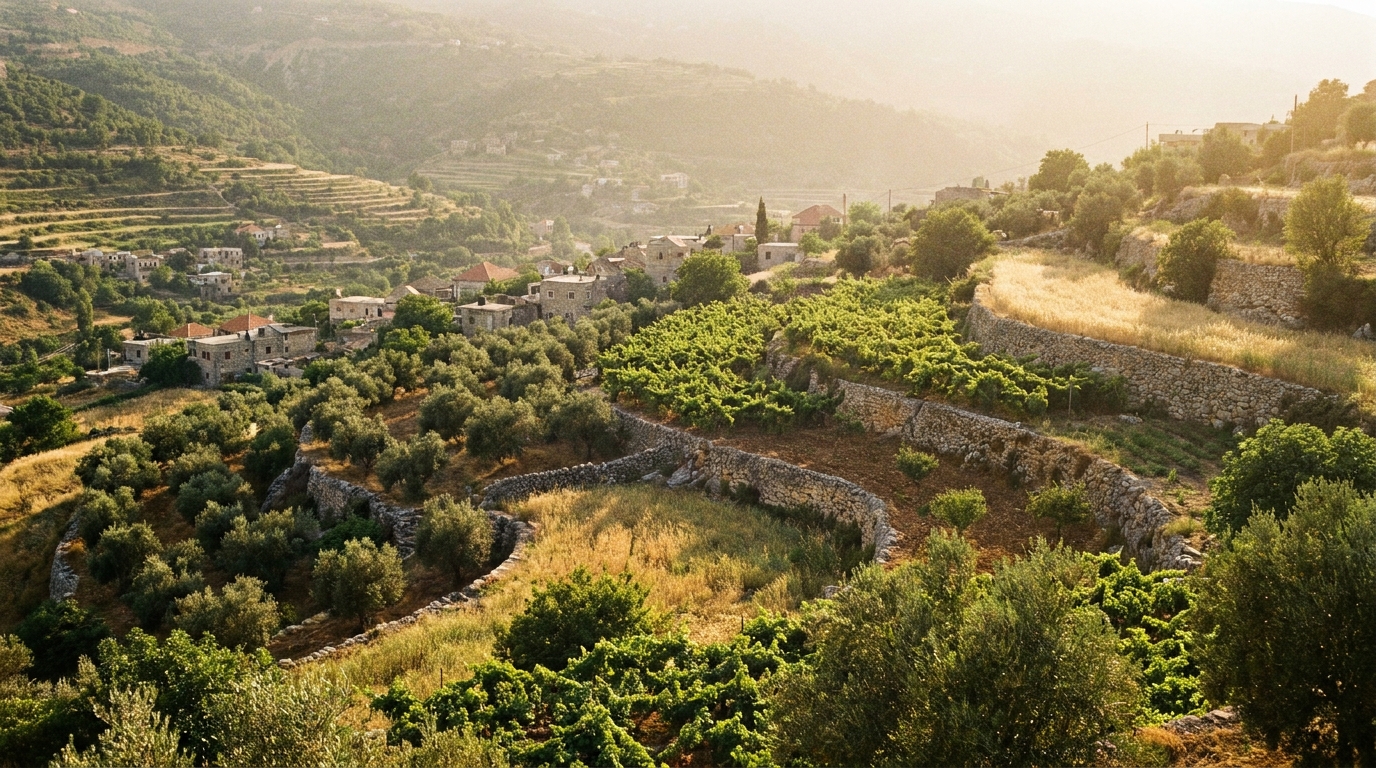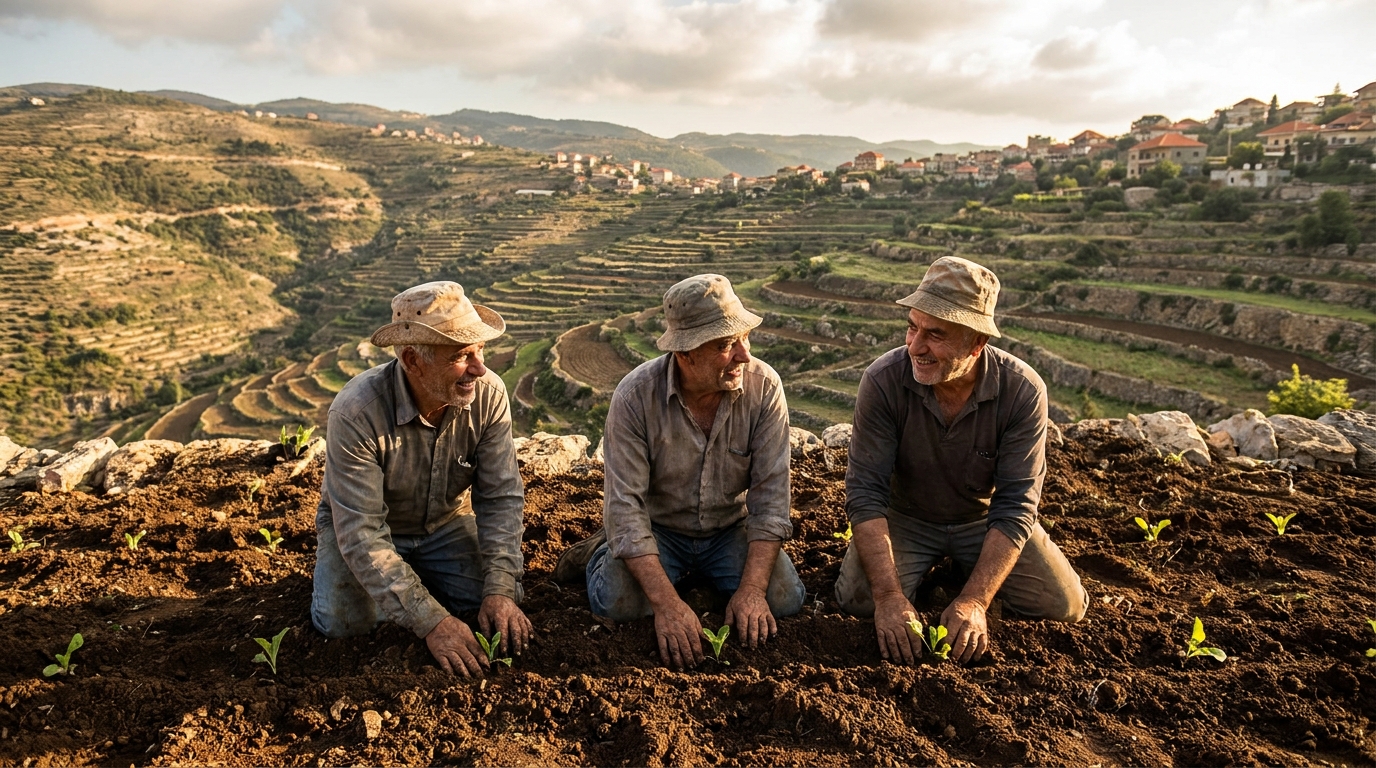
The mountains of Lebanon hold something that lowland planners rarely understand: a particular social ecology in which land, community, and memory are inseparable. In the Chouf District, with its terraced hillsides, its mixed-faith villages, its tradition of communal forest stewardship, any serious agricultural intervention must begin not with soil chemistry or market access, but with the question of who belongs to the land and how they belong to each other.
An agricultural initiative in Lebanon's Chouf District began with precisely that question. What emerged over years of applied ecological practice was not simply a farming project, it was a proof-of-concept for the NASF framework, and a demonstration that the cooperative model, when its conditions are honestly assembled, can be both ecologically sound and institutionally durable.
The Chouf Context
The Chouf District occupies the central mountain range south of Beirut. Historically one of Lebanon's most productive agricultural regions, its terraced slopes once supported mulberry cultivation for silk production, olive groves, and mixed subsistence farming. Decades of urban migration, political instability, and the economic dislocation that followed the civil war left many of those terraces abandoned and the knowledge systems surrounding them fragmented.
What remained was a landscape with extraordinary ecological potential and a social fabric that, despite everything, still carried the memory of collective land management. The Chouf Biosphere Reserve, established in 1996, had already demonstrated that coordinated environmental stewardship was possible in the area. The agricultural initiative extended this logic from conservation into production: could smallholder farmers in the Chouf region cooperate not merely to protect the land, but to make a living from it regeneratively?
The ecology of the Chouf is particular. Altitude variation across relatively short distances creates microclimatic diversity that favours a wide range of crops, from olives and figs at lower elevations to stone fruits, herbs, and cereals higher up. This diversity is an asset in a cooperative model: it allows complementary specialisation across member farms rather than competition within a single commodity. It also creates natural resilience. A cooperative with diversified production across members is less vulnerable to single-crop price collapses than an individual monoculture farm.
The social structure of the Chouf was equally relevant. Village-based identity remains strong. Decisions made outside the community are viewed with scepticism, not unreasonably, given Lebanon's history of external interventions that promised transformation and delivered dependency. Any cooperative structure would have to be genuinely owned by its members, governed by them, and accountable to them. There was no shortcut available.
Why Cooperatives Work (and Why They Fail)
The cooperative model has a distinguished theoretical heritage and an uneven empirical record. It works, when it works, because it addresses three structural disadvantages that smallholder farmers face individually: purchasing power, market access, and knowledge. By pooling resources, cooperative members can buy inputs at scale, negotiate better prices for their produce, and share technical knowledge across the group. The whole is demonstrably more capable than the sum of its parts.
But cooperatives also fail, and they fail in recognisable ways. The most common failure mode is power concentration, one or two members capturing the governance process and using it to extract disproportionate benefit. A second is the free-rider problem: members who benefit from the collective but contribute less than their fair share, gradually eroding the goodwill that holds the structure together. A third failure mode is insufficient governance design, cooperatives formed around shared purpose but without clear rules about decision-making, profit distribution, and member obligations.
"What the Chouf taught us is that cooperatives don't fail because the model is wrong. They fail because the conditions for the model, trust, shared purpose, patient capital, were never truly assembled."
- Rima TahaUnderlying all three failure modes is the same structural vulnerability: cooperative success depends on social capital that cannot be manufactured on a project timeline. Trust is accumulated slowly and lost quickly. Shared purpose must be genuine, not performed. And the patient capital required to sustain a cooperative through its early, difficult seasons is rarely available from conventional agricultural finance.
What the Chouf initiative demonstrated was that these conditions can be deliberately cultivated, but only if the process is honest about how long it takes and what it requires. The facilitation process that preceded formal cooperative registration lasted considerably longer than most project timelines would tolerate. That patience was not inefficiency. It was the investment.
The Structural Elements That Matter
Three structural elements proved non-negotiable in the Chouf prototype. First, the legal form had to be genuinely cooperative, not a project entity managed by an NGO, not a producer group controlled by a single commercial partner, but a legally registered cooperative in which members had real governance rights. The Lebanese cooperative law, while imperfect, provided a framework that members could own and defend.
Second, the governance mechanism had to be designed before the cooperative was tested by conflict, and conflict, in any cooperative, is inevitable. Decisions about input purchases, marketing contracts, and profit distribution are inherently contentious. Having clear, pre-agreed rules about how those decisions are made, who has a vote, and what constitutes a quorum meant that conflict, when it arrived, was managed rather than destructive.
Third, the resource-pooling architecture had to match the actual assets of the members. In the Chouf, the most significant pooled resource was not capital, most members had little, but land access and labour time. The cooperative mechanism for labour exchange, seasonal rotation planning, and coordinated harvest scheduling was therefore more central than the financial model in most conventional cooperative designs.
| Element | Conventional Farm Model | Cooperative Model |
|---|---|---|
| Input sourcing | Individual purchase (higher cost) | Collective purchase (lower cost) |
| Market access | Individual negotiation | Shared channels + collective bargaining |
| Knowledge | Siloed to individual | Shared across members |
| Risk | Borne individually | Distributed across cooperative |
| Capital | Owner-financed or bank debt | Cooperative fund + grants |
The seasonal rhythm of the Chouf prototype also proved structurally important in a way that was not initially anticipated. Cooperative cohesion is not constant, it ebbs and flows with the agricultural calendar. The period of collective decision-making around planting, the intensity of cooperative labour during harvest, and the quieter periods between growing seasons all affect the social dynamics of the group in different ways. Designing the governance calendar to align with the agricultural calendar, holding formal general assemblies during the natural gathering points of the farming year, made participation more natural and improved attendance and engagement.
Replicating the Model at Scale
The distinction between a prototype that works in one specific context and a framework that can be replicated across diverse contexts is not semantic, it is the central challenge of agricultural development. The Chouf cooperative worked because of a particular constellation of conditions: the ecological diversity of the landscape, the social memory of collective land management, the patience of the facilitation process, and the specific governance design that emerged from that place and those people.
Replication does not mean transplantation. What can be systematised is not the specific cooperative, it is the process by which cooperatives are developed, the analytical tools for assessing local conditions, the governance templates that can be adapted rather than imposed, and the facilitation methodology that creates the conditions for genuine ownership.
Institutional scale is not the same as cooperative scale. Ministries and NGOs need frameworks that can be deployed, monitored, and adapted by people who were not present at the prototype. This is the translation challenge NASF was designed to solve.
The NASF framework was built from the Chouf experience precisely to enable this translation. It codifies the facilitation methodology into a sequence of steps that can be followed by agricultural extension workers who were not present in the Chouf. It provides governance template documents that can be adapted to local legal contexts. It specifies the diagnostic criteria for assessing whether a community's social capital is sufficient to sustain a cooperative, and what preliminary work is needed if it is not.
Community Convening
Establish shared purpose, map actors, build initial trust, before any formal structure is proposed.
Structural Design
Legal cooperative form, membership agreements, and governance rules, co-designed with prospective members.
Resource Pooling
Land, equipment, knowledge, and market access coordination, mapped to actual member assets.
Seasonal Operations
Rotation planning, input management, and coordinated harvest, aligned with the agricultural calendar.
Institutional Integration
Relationship with ministries, NGOs, and financing bodies, selective, deliberate, and governance-protective.
Critically, the NASF framework does not promise that cooperatives will succeed everywhere it is applied. It promises to identify, before significant resources are committed, whether the conditions for cooperative success are present, and if they are not, what would need to change. This honest diagnostic function is arguably more valuable than any governance template. It prevents the waste of resources on cooperative formation efforts that are unlikely to succeed, and it identifies the specific preparatory work that would improve the odds.
Lessons for Institutional Partners
For NGOs, ministries, and international bodies that want to work with cooperative models, the Chouf experience generates five practical lessons that have been consistent across the diverse contexts in which the NASF framework has subsequently been applied.
The first lesson is about what to fund. The most important investment in cooperative development is not the cooperative itself, it is the facilitation process that precedes it. Funding community convening, trust-building, governance design, and participatory diagnostics is rarely glamorous and rarely fits standard project-cycle timelines. But this pre-formation investment is what determines whether the cooperative that emerges is genuinely owned by its members or merely formally registered.
The second lesson is about what to protect. Once a cooperative is formed and functioning, the most important thing an institutional partner can do is protect its governance autonomy. Reporting requirements, compliance conditions, and technical assistance arrangements all have a tendency to drift toward institutional capture, the gradual subordination of member governance to the preferences of the funding body. Designing partnership agreements with explicit boundaries on institutional influence is not bureaucratic paranoia. It is the structural protection that cooperative governance requires.
The third lesson is about what to measure. Standard agricultural project metrics, yields per hectare, income per household, market participation rates, are necessary but insufficient for evaluating cooperative health. The indicators that actually predict cooperative durability are social: member participation in governance, labour contribution equity, conflict resolution effectiveness, and member willingness to invest their own resources in the cooperative. These are harder to measure and harder to report, but they are the leading indicators of whether a cooperative will still be functioning after the project funding ends.
The fourth lesson is about what not to fund for too long. Subsidy dependency is a cooperative killer. Cooperatives that are sustained by external grants rather than member contributions and market revenue cannot develop the financial discipline and market orientation they need for long-term survival. The transition from project-funded to member-funded should be planned from the beginning, with explicit timelines and declining external support built into the partnership design.
The fifth and perhaps most counterintuitive lesson is about what to stay out of. Institutional partners, however well-intentioned, should not be present in cooperative governance meetings, should not have representation on cooperative boards, and should not make operational decisions on behalf of the cooperative, even when those decisions might be technically superior to what the members would choose. The cost of undermining member ownership is always higher than the cost of a suboptimal crop rotation decision. Every time an institutional partner overrides member judgment, it borrows against the social capital that makes the cooperative durable, and that debt comes due at the worst possible moment.
The Chouf prototype demonstrated something that is easy to state and difficult to enact: that the cooperative model, at its best, is not an agricultural intervention. It is a form of collective self-determination expressed through agriculture. When institutional partners understand this, and design their engagement accordingly, the model can travel.
Want to work together?
Rima advises organisations navigating the intersection of AI search, digital governance, and systemic transformation.
Collaborate With Me →